The BRIDGE Program · Proprietary Methodology
A structured, staged pathway to investment readiness — built around how DFIs actually make decisions.
BRIDGE integrates financial viability, ESG safeguards, governance, and delivery systems into a single readiness pathway, assessed progressively across four dimensions. Designed specifically for climate, forestry, regenerative agriculture, and land-use initiatives engaging with development finance institutions and institutional impact capital.
Why BRIDGE Exists
Most investment readiness support is built around compliance checklists. BRIDGE is not.
Standard advisory approaches treat financial structuring, ESG compliance, governance, and delivery planning as separate workstreams — addressed sequentially, by different specialists, against different frameworks. The result is documentation that satisfies individual requirements but lacks the coherence that institutional capital providers need to deploy with confidence.
BRIDGE was designed from inside both sides of the transaction — by practitioners who have structured investments within development finance institutions and implemented ESG and delivery systems in complex field contexts across Africa, Latin America, and Southeast Asia. It addresses not just what needs to be in place, but how it needs to be documented, governed, and evidenced to withstand institutional scrutiny at every stage of the investment process
Why BRIDGE Exists
Four dimensions. One structured gap analysis.
The IRAT framework is organised into 4 core dimensions, structured into 16 categories and supported by a comprehensive set of 116 criteria — collectively guiding assessment across financial viability, environmental and social safeguards, governance integrity, and implementation readiness. Each criterion is scored on a structured scale. Gaps are identified, classified as critical or non-critical, and converted into a prioritised action roadmap that drives the readiness process.
IRAT is delivered through a dedicated project workspace — tracking stage progress, gap registers, action plans, document management, investor engagement, and IR package delivery in a single integrated platform.
The BRIDGE IRAT platform is available for guided demonstration to project sponsors, funds, and institutions exploring investment readiness support.
The Four Dimensions of Investment Readiness
Investment readiness cannot be reduced to a single assessment. Institutional capital providers evaluate these four dimensions together — gaps in any one of them can stall an otherwise strong initiative
DIMENSION A
Financial Viability
Economic logic, capital structure, partner configuration, revenue pathways, and documentation aligned with concessional, blended, or commercial capital structures.
DIMENSION B
E&S, Livelihoods & Safeguards
Environmental, social, biodiversity, climate, and operational safeguards assessed as an integrated system. IFC PS1–8, EU Taxonomy, TNFD, EUDR, HCV/HCS, GRI, FAO VGGT, ILO standards. The largest dimension — reflecting the weight DFIs place on safeguards in complex land-use contexts.
DIMENSION C
Governance & DFI Compliance
Legal structure, decision-making architecture, transparency, integrity controls, and accountability frameworks required for institutional engagement.
DIMENSION D
Delivery & Funder Readiness
Implementation credibility, stakeholder protocols, monitoring systems, and capital-facing reporting — structured for institutional review and funder support throughout the investment lifecycle.
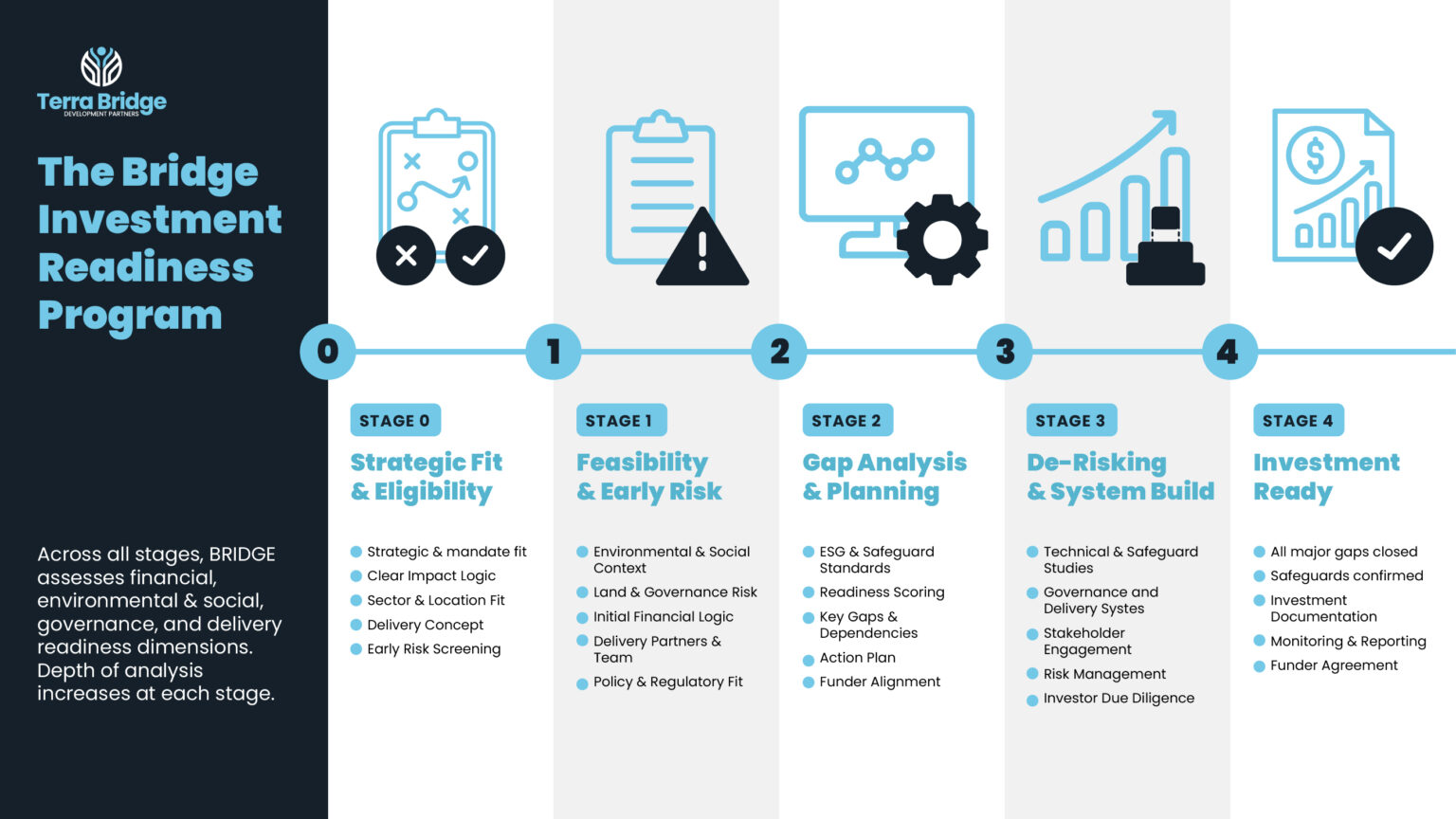
The Readiness Pathway
Five stages. Progressive, gated, and proportionate.
Each stage deepens alignment across all four dimensions and supports informed decisions about whether and how to proceed. Depth of analysis increases at each stage. No stage is entered without the previous one establishing a clear foundation.
Frameworks & Standards · 12 Mapped
Assessed against the frameworks institutional capital providers actually apply.
BRIDGE maps compliance and readiness requirements across the specific frameworks that DFIs, impact funds, and blended finance facilities use to make investment decisions — with gap analysis and cross-standard alignment built into the IRAT platform.
IFC PS1–8
VERRA VCS
GS4GG
EU Taxonomy
SFDR
CSRD
EUDR
HCV/HCS
TNFD
GRI
FAO VGGT
AFOLU
Frequently Asked Questions
Q1: Who is the BRIDGE Program designed for?
BRIDGE is designed for project sponsors, developers, and funds operating climate, forestry, regenerative agriculture, or nature-based solutions initiatives who face material readiness gaps in financial viability, governance, ESG safeguards, or delivery systems. It is applied selectively — where readiness gaps exist and where structured support adds value relative to direct capital engagement.
Q2: How long does a BRIDGE engagement typically take?
Stage 0 can be completed in one to two weeks. A full Stage 1 diagnostic typically requires three to six weeks depending on project complexity and information availability. Progression through Stages 2–4 depends on the scope and severity of gaps identified — targeted mandates range from three to eighteen months.
Q3: Is BRIDGE available as a standalone or partial engagement?
Yes. Clients may engage TerraBridge for individual BRIDGE stages, targeted gap-filling mandates such as ESMS design or governance restructuring, or full end-to-end readiness support. Where financing is already in place or specific DFI requirements must be addressed, TerraBridge provides tailored advisory drawing on BRIDGE methodology without requiring full program enrollment.
Q4: How does BRIDGE relate to IFC Performance Standards?
IFC PS1–8 are core assessment criteria within BRIDGE Dimension 03. The program assesses not only technical PS compliance but the institutional systems, documentation, and monitoring capacity required to demonstrate compliance credibly to lenders and equity providers throughout the investment lifecycle.
Q5: What is the IRAT and how does it connect to BRIDGE?
IRAT (Institutional Readiness Assessment Tool) is the diagnostic engine at the core of BRIDGE. It assesses 116 criteria across four dimensions: financial and sponsor capability, ESG and safeguards, governance and institutional integrity, and delivery and funder readiness. IRAT outputs a scored gap analysis that becomes the structured action roadmap for Stages 2 through 4.
Q6: Does BRIDGE cover biodiversity, critical habitats, and IFC PS6?
Yes. Biodiversity conservation, critical habitat assessment, and the IFC PS6 mitigation hierarchy are explicitly covered within Dimension 3 (Environmental, Social & Operational Safeguards). BRIDGE also covers PS7 (indigenous peoples and FPIC), EUDR compliance, and ecosystem services assessment. These are assessed as integral components of investment readiness, not as optional add-ons, because institutional capital providers treat them as material risk factors.
Q7: Can BRIDGE be applied to initiatives already in dialogue with a DFI?
Yes. BRIDGE can be applied at any stage, including where initial DFI contact has already occurred but specific gaps have been identified. In some cases, the most valuable application is targeted — addressing a specific dimension (for example, completing FPIC documentation or strengthening governance arrangements) rather than the full programme.
Bridge is applied selectively - only where it adds genuine value
If your initiative faces material readiness gaps across financial viability, governance, ESG safeguards, or delivery systems, BRIDGE provides the structured pathway to address them. If you are already institutionally aligned, we will tell you that directly and recommend the most efficient path to engagement.